Kevyn Duane Orr was appointed as Emergency Financial Manager of the City of Detroit by Governor Rick Snyder on March 14, 2013. A mere 11 days later, with Orr's assumption of the position, democracy was put on pause in the city. Control over the city would not be handed back to the locally elected City Council and Mayor until December of the following year. During those 21 months, Detroit would be led by a man who could not be held responsible by any of the people he was trusted to serve. As a State-appointee under Public Act 436 (2012), Orr would answer only to the Governor, even though his powers included overruling the decisions made by the Mayor and the Council. Thus, Orr's political power as EM would be without the agreement, consent, and vote of the constituency, the opposite of Locke had envisioned.
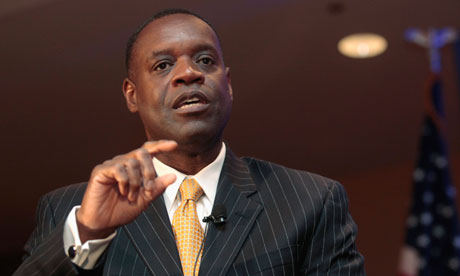 |
| Emergency Manager Kevyn Orr |
When Orr's tenure as EM began, Raquel Castañeda-López was just another Detroiter, and didn't think much of his appointment, since it didn't affect her and her family directly. When I spoke to her last week, she emphasized that "in reality, we knew he was there, but he hadn't changed anything. We didn't notice a difference because we still had no street lights and our daily quality of life was the same as before." But in November of that same year, Raquel made history by becoming the first Latina elected to the Detroit City Council.
That was when she began to notice the EMs unilateral influence over the city. As a councilmember, she noticed "the contracts we got, and the ones we didn't get. We were always pressured to vote quickly, and vote in the way he wanted. If we didn't, he'd overturn it and get his way anyway. There was a lack of transparency, and there was really no point to voting since we couldn't do anything." Even since his departure, the City Council has been bound by Orr's orders, with them " still effecting us today."
 |
| Councilmember Raquel Castañeda-López |
In her view, "the [re-passing of the law] is totally unethical, and I would argue that it's illegal. The people opposed it, words were changed, and it was re-passed. It was a slap in the face of democracy. That is not how you run a successful democracy." Echoing the councilwoman, I do believe that the action taken by the legislature in passing a law rejected by the people through veto referendum, should be illegal. The state's overreach impedes the rights of the residents of Michigan, and the procedural moves used to achieve it should be outlawed.
In the Gettysburg Address, one of the most popular speeches in American history, President Abraham Lincoln coined a phrase defining democracy that remains in use to this day. On the afternoon of Thursday, November 19, 1863, while dedicating the the Soldiers' National Cemetery, Lincoln reassured the crowd by saying, in the midst of the Civil War, that "we here highly resolve ... that this nation, under God, shall have a new birth of freedom -- and that government of the people, by the people, for the people, shall not perish from the earth."

For the sake of the citizen and the democratic foundation of our nation, the State must a) actively work to reaffirm local control and voter-initiated referenda, and b) outlaw the measures used by the legislature to subvert it in the first place.
Next time, in the final post of this series, we'll delve into the darkest corners of the harm left in the wake of Public Act 436 (2012), and the third step to restoring democracy in the State of Michigan.

I enjoyed the read. However, I would like to bring up the point that because we the people elected Gov. Snyder we consent to his decisions via the Lockean concept of democracy and therefore we adhere to his decisions that are supposed to be in the best interest of us all. Just a thought. Nice post!
ReplyDeleteI respectfully disagree, firstly because it's now obvious that his decisions were not in the best interest of all. Secondly, the same voters who elected him decided that one of his policies was improper, and thus repealed it. He overstepped his bounds once he championed a replacement law that, by the inclusion of an appropriation, was voter-referendum proof. He overruled the people, and then took away their right to overrule him.
Delete