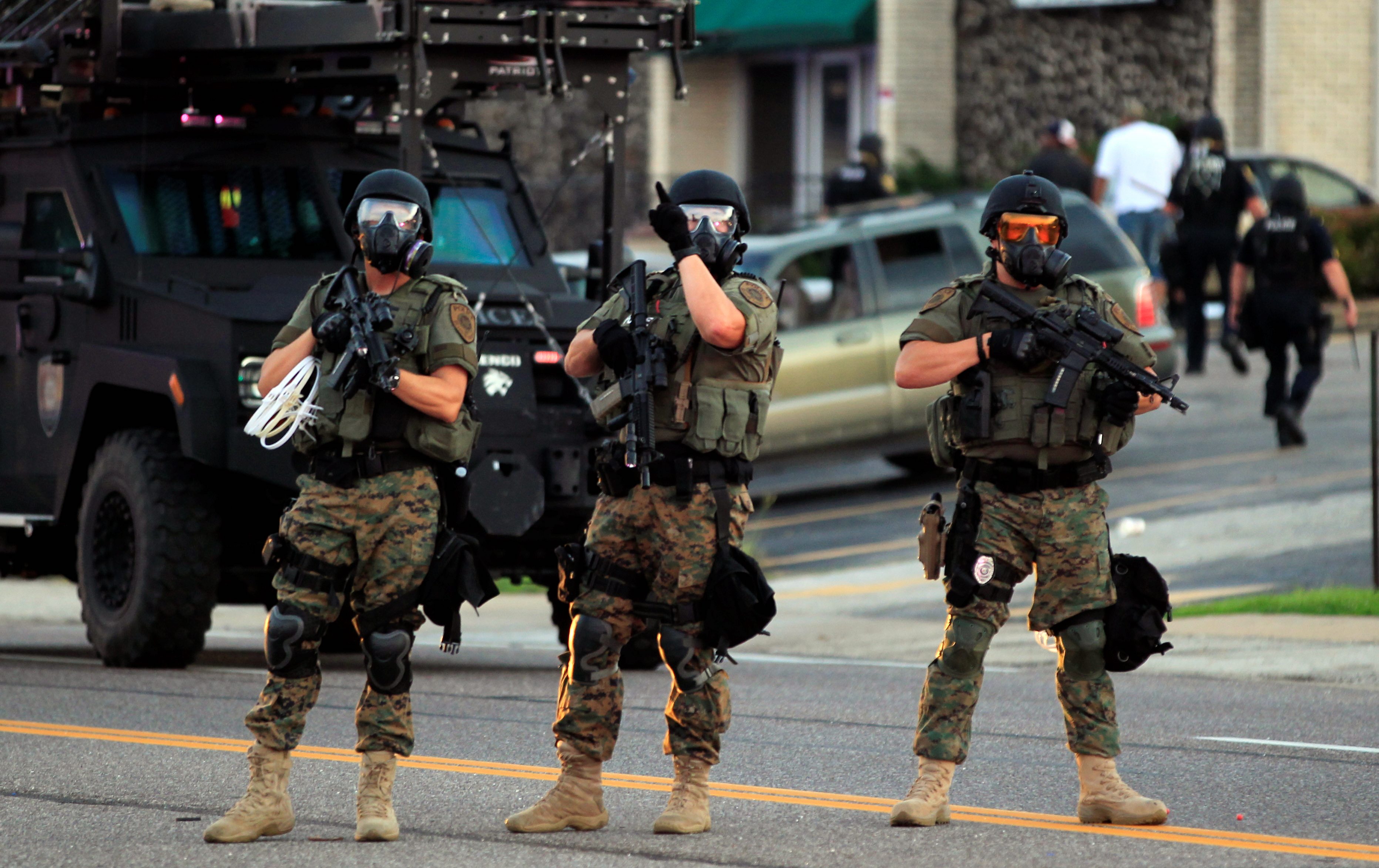
"And you know now, if you did not before, that the police departments of your country have been endowed with the authority to destroy your body. It does not matter if the destruction is the result of an unfortunate overreaction. It does not matter if it originates in a misunderstanding. It does not matter if the destruction springs from a foolish policy...your body can be destroyed."
-Ta-Nehisi Coates
We left off my last post with a number of questions unanswered. All are important, but the true question at hand
relates to the use of violence between citizens in our society, and in my
county. Is there a place for violence enacted for the common good, and if so,
should there be equality in the capability for violence?
In “The Politics,”
Aristotle discussed the relationship that is to be maintained between all
members of a society. Aristotle stated that, “those regimes which look to the
common advantage are correct regimes…while those which look only to the
advantage of the rulers are errant…for they involve mastery, but the city is a
partnership of free persons” (Aristotle 95). It seems that the Aristotelian
conception of governance lends itself to a society wherein the people are the
equals of the ruler. Yet, it would also seem to be the case that if the ruler
were to have an excessive capacity for violence over the citizenry, this
relationship would crumble in the face of inequality.
If we were to
level the accusation that the police are enacting society-wide violence upon
the average citizen, we would be living in a world of hyperbole. The power of
American policing today is brought down not upon the head of Joe the Plumber,
but on Joe the Coke Dealer, or Joe the Arms Dealer—criminals, or, more
accurately suspected criminals. To
put it another way—innocent men and women. Let’s never forget that there is
always to be a presumption of innocence. So, we are left with a sect of society
made up of individuals who may or may not have committed a crime, but are still
fully citizens and members of the society, on equal grounds not only with the
common man, but with the police carrying out their duties. If they are
subjected to violence in some excessive manner, does the relationship between
the citizen and ruler not fall?
LaQuan McDonald's death recorded on dashcam. Note that McDonald was armed with a knife at the time.
Iris Marion Young,
in her seminal work on what she called the “Five Faces of Oppression,” noted
violence as the final form of oppression. To set the frame, it should be
understood that if there is an oppressed sect of our society, that is an
indication of a democratic failure. I also will note that in the context of
Young’s work I would like to utilize the term violence to mean excessive violence borne of an
inequality of defensive capabilities between the police and suspected
criminals. In Young’s words, “What makes violence a phenomenon of social
injustice, and not merely an individual moral wrong, is its systemic character,
its existence as a social practice” (Young 62). In other words, if we are
witnessing the sanctioning of violence (again, in excess) against suspected
criminals in our society, we are witnessing the oppression of members of the
citizenry who are in essence relegated to the place of the lesser. If this is
the case, the equality amongst citizens that the Aristotelian strives for is
gone.
So let’s take it
one step further. Let’s assume that we are able to curtail the enactment of
excessive violence against suspected criminals. Let’s imagine a situation
wherein the police simply held the capability
to enact this form of violence. Would this still constitute a democratic
failure? The short answer seems to be yes, but let’s look a little closer.
Locke held that, “the power of the Society, or Legislative constituted by them,
can never be suppos’d (sic) to extend farther than the common good” (Locke
353). What is the common good? It would
seem to be the realization of a society without oppression. Of note is the fact
that Locke describes not the actions,
but moreso power, or in other words
governmental capability to reach beyond the common good. It seems to be the
case that if the Oakland County Sheriff’s Department held equipment that
provided them with militaristic capabilities that went unused, their simple
presence in the inventory of the Sheriff’s department would still constitute a
democratic failure. The dominoes would fall like so: the police hold the power
of excessive violence, which, if it were to be used, would be brought down upon
the suspected criminals in society, which, if it were to happen, would
constitute a democratic failure in the Aristotelian and “Young-ian” sense as
stated above.
If we live in a society in which the powers of
the ruler and the ruled are unequal, we live in a society where democracy has
failed. If a single power between some sect of society and the ruler of said
society is unequal, we are witnessing a democratic
failure. If suspected criminals are subject to excessive violence or even
the possibility of excessive violence,
this would constitute a democratic failure. What is left to be discussed is the
question of whether or not the use of 1033 equipment leads to the
implementation of violence in excess. This question will be discussed in my
third and final post, as will the question of how we may resolve a democratic
failure of the sort herein described.

Author’s Note: I
believe that it is of the utmost importance that it is understood that this
post specifically is not intended to disparage or in anyway accuse the Sheriff’s
Department of Oakland County of causing a democratic failure. The purpose of
this post is simply to discuss the conditions under which a democratic failure
would have occurred in the philosophical sense. The full question of whether or
not the current situation constitutes a democratic failure shall be discussed
in my final post.
Bibliography
Aristotle, and Carnes Lord. The Politics. Chicago: U of Chicago, 1984. Print.
I'm a Respectable Citizen. N.d. AZ Quotes. A-Z Quotes. Web.
Locke, John, and Peter Laslett. Two Treatises of Government. Cambridge: Cambridge UP, n.d. Print.
Police in Combat Gear. N.d. Washington Times, Ferguson, MO. Washington Times. Web.
Young, Iris Marion. Justice and the Politics of Difference. Princeton, NJ: Princeton UP, 1990. Print.

Great analysis, and I agree completely. However, what would you say to those who don’t believe this equipment extends farther than the common good? One could argue that this equipment is necessary for the public’s security, that it is there as insurance in the case of a terrorist attack, for example. Because the people have the power to elect representatives to prevent abuse, it could be argued that the people still hold enough power for the government to refrain from excessive violence with this equipment. Is representative government not enough to balance the power between the government and the people? Again, I don’t believe so, but I thought I’d play devil’s advocate here.
ReplyDeleteEd,
DeleteI would check out my final post as I more or less answer your question. For me it is a matter of 1) size and resulting capability of the police force, specifically their "militarized" units, 2) how often the equipment is used and in what capacity, and 3) responsiveness and attitude of the elected official in charge. One thing that the Sheriff really emphasized was, in his words, "There isn't a police force in America that isn't headed by an elected official." State police and federal police such as the FBI are somewhat indirectly controlled by an elected official, but I believe the point still stands. The power of the people in a democracy is largely reactive, so governmental power largely becomes an issue when officials are non-responsive and/or when the people are thoroughly oppressed. I would argue that in this country there are police departments that fit the mold of a "democratic failure," but in Oakland County I don't believe this to be the case.